
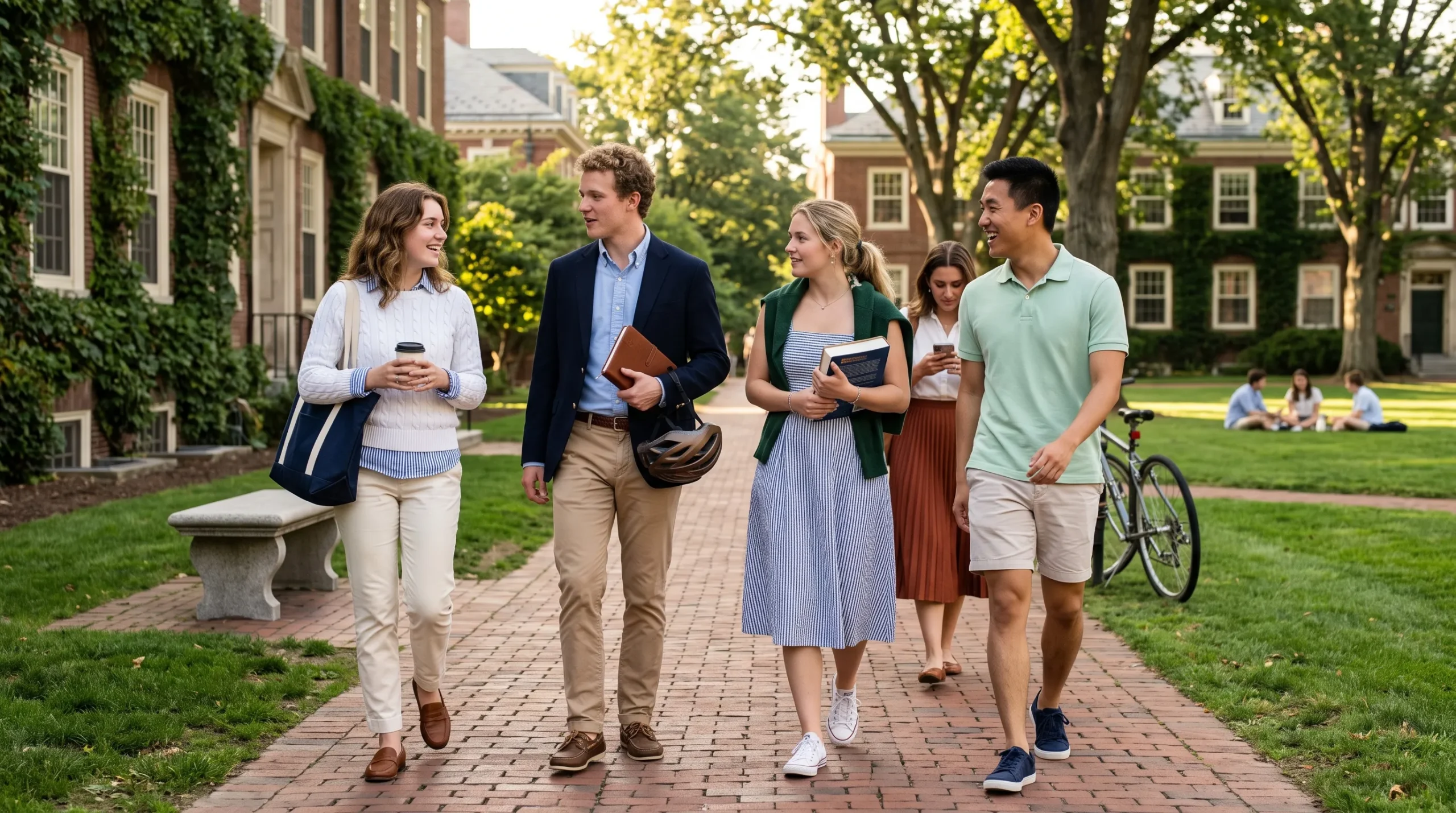
Preppy style is a polished, classic approach to dressing that originated in the preparatory schools and Ivy League universities of the American Northeast during the early twentieth century. It centres on well-fitted basics — oxford shirts, chinos, blazers, loafers, and cable-knit sweaters — worn in a restrained colour palette of navy, white, cream, and pastels, with an emphasis on quality fabrics over visible logos.
Most style guides treat preppy as a trend that cycles in and out of fashion. It is not. According to Lisa Birnbach, author of The Official Preppy Handbook (1980), the aesthetic has survived every major fashion cycle of the past four decades precisely because it functions as a wardrobe system rather than a seasonal look. The problem is that the word “preppy” now means two entirely different things to two different generations: a polished, understated classic look to anyone over thirty, and a pink-and-bows TikTok aesthetic to Gen Z. That confusion makes it hard to know what preppy actually is — and harder still to dress the part without a clear framework. This guide resolves that split by covering both interpretations, their shared origins, and the specific pieces and principles that make preppy work as a permanent wardrobe strategy rather than a passing mood.
Preppy fashion draws its visual DNA from sports traditionally associated with the upper class — tennis, sailing, rowing, polo, and golf — and adapts the clothing worn for those activities into everyday campus and office wear. The term itself is an abbreviation of “preparatory,” referring to the college-preparatory boarding schools of New England whose students developed this aesthetic in the 1920s and 1930s.
Core fabrics include oxford cloth, seersucker, madras, linen, and cable-knit wool. Core silhouettes favour structure without stiffness: shoulders that sit naturally, trousers with a clean taper, and outerwear that skims rather than clings. The result is a wardrobe that reads as deliberate but never overdressed — a quality fashion historian Patricia Mears of the Museum at the Fashion Institute of Technology described as “a high standard of excellence in personal appearance” defined by “the importance of never looking ‘dressed up’ while always looking well dressed.”
In 2026, brands like Aimé Leon Dore, Drake’s, and Rowing Blazers have joined heritage names like Ralph Lauren and Brooks Brothers in shaping a looser, more inclusive version of this aesthetic that retains its foundational pieces while broadening its colour palette and relaxing its fits.
What Does Preppy Style Actually Mean in 2026?
Preppy style in 2026 is a polished, classic aesthetic built on structured basics, natural fabrics, and a restrained colour palette — worn with a looser, more relaxed silhouette than earlier decades and stripped of the exclusionary social codes that once defined it.
The word “preppy” traces back to the college-preparatory schools of the American Northeast. Students at institutions like Phillips Exeter, Choate, and Deerfield developed a specific way of dressing during the 1920s and 1930s that blended British country clothing (tweed jackets, brogues) with the sportswear of upper-class leisure activities (polo coats, tennis whites, deck shoes). This campus aesthetic spread to the Ivy League — Princeton, Harvard, Yale — and became codified as “Ivy style” by the 1950s.
Ivy style was the precursor. Preppy was its more casual, youthful descendant. Where Ivy meant button-down collars and repp ties worn with precision, preppy loosened the collar, added colour, and incorporated more sportswear: rugby shirts, boat shoes, pastel polo shirts, and Bermuda shorts. Brooks Brothers, founded in 1818, dressed both eras. J. Press served as what many consider the quintessential Ivy clothier. And when Birnbach published The Official Preppy Handbook in 1980 — intended as satire — it inadvertently fuelled a mainstream preppy boom that lasted through the decade.
By 2026, the aesthetic has split into two distinct lanes. Traditional preppy references Ralph Lauren, Brooks Brothers, Lacoste, and the Ivy League visual vocabulary: structured blazers, oxford cloth button-down shirts, loafers, cable knits, and nautical motifs. TikTok preppy — sometimes called “Gen Z preppy” or “prep-core” — centres on hot pink, hair bows, Stanley tumblers, and a maximalist, hyper-feminine sensibility aimed at a younger audience. Both use the same word. They describe different things. This guide focuses on the traditional interpretation and its modern evolution, because that version functions as a permanent wardrobe system rather than a seasonal mood.
The History of Preppy: From Princeton to the Present
The Ivy League look took shape on the campus of Princeton University between the First and Second World Wars. Princeton’s relative isolation in rural New Jersey allowed its predominantly male, Protestant student body to experiment with the sporting and high-society clothing popular in Britain: tweed sport coats, polo coats, and the button-down collar shirt that Brooks Brothers introduced in 1896 after company founder John Brooks spotted polo players in England pinning their collars down during matches.
A 1933 Apparel Arts article captured the ethos: the American university man was “justly famed for representing, as a class, a high standard of excellence in personal appearance.” The secret was “the importance of never looking ‘dressed up’ while always looking well dressed.” That tension — polish without performance — remains the defining principle of preppy style nearly a century later.
Three key moments shaped the aesthetic’s trajectory:
The Japanese documentation (1965). A group of style enthusiasts including Toshiyuki Kurosu and Shosuke Ishizu travelled from Japan to photograph Ivy League campuses, producing the book Take Ivy. Their images became a reference text for the “Ivy” look in Japan, where brands like Van Jacket translated the aesthetic for a Japanese audience. Take Ivy was rediscovered by Western audiences in 2010 and helped trigger the current preppy revival.
The Preppy Handbook (1980). Birnbach’s satirical guide sold over a million copies and detailed everything from appropriate pets (dogs, not cats) to the correct way to care for madras cloth. The book glamorised the culture it meant to mock, and preppy fashion exploded into the mainstream throughout the 1980s.
The Aimé Leon Dore era (2014–present). Teddy Santis’s New York brand proved that preppy codes — rugby shirts, loafers, cable knits, country-club colours — could be recontextualised through streetwear, hip-hop, and multicultural New York sensibility without losing their visual identity. Tyler, the Creator and André 3000 have done similar work, demonstrating that the aesthetic’s visual language transcends the demographic that created it.
The 12 Wardrobe Pieces That Define Preppy Style
Every preppy wardrobe is built from a finite set of foundational pieces. These twelve items form the core. Quality matters more than quantity — three well-made pieces outperform ten mediocre ones.
| Piece | Key Details | Fabric | What Makes It Preppy |
|---|---|---|---|
| Oxford cloth button-down shirt (OCBD) | Soft collar with visible “roll,” button-down points | Oxford cloth cotton | The single most important preppy garment — wear it tucked, untucked, under a sweater, or with a blazer |
| Navy blazer | Unstructured or half-lined, gold or brass buttons | Wool, cotton, or linen blend | The one jacket that works at a dinner, a campus event, and a job interview |
| Chinos | Mid-rise, straight or slightly tapered leg | Cotton twill | In khaki, navy, olive, or stone — the everyday trouser |
| Polo shirt | Two- or three-button placket, soft collar | Piqué cotton | Originally tennis and polo sportswear, now a casual staple |
| Cable-knit sweater | Crewneck or V-neck, generous fit | Merino wool, cotton, or cashmere | In cream, navy, or hunter green — worn alone or layered over an OCBD |
| Loafers | Penny or tassel style, leather sole | Full-grain leather | Bass Weejuns are the heritage choice; worn with or without socks |
| Boat shoes | Handsewn moccasin construction, rawhide lacing | Oiled leather or canvas | Sperry Top-Siders remain the reference — campus, boat, and weekend |
| Striped rugby shirt | Heavy cotton, contrasting white collar | Jersey cotton | Bold horizontal stripes in red, navy, green, or gold |
| Trench coat or Harrington jacket | Classic cut, minimal hardware | Cotton gabardine or cotton-poly | The preppy outerwear default for transitional weather |
| Madras or plaid shirt | Bright, bleeding-dye check pattern | Madras cotton or lightweight flannel | The summer pattern signature |
| Canvas tote or leather satchel | Clean lines, minimal branding | Canvas, waxed cotton, or leather | L.L. Bean Boat and Tote is the reference |
| Grosgrain or surcingle belt | Ribbon or woven elastic with leather tabs | Grosgrain ribbon, leather | The finishing detail that signals “preppy” without trying |
These twelve pieces generate dozens of outfits through combination. That interchangeability is the system’s real value — and why preppy works as a capsule wardrobe strategy rather than a trend to chase.
Preppy Style vs Old Money Aesthetic: What Is the Actual Difference?
Preppy is a style choice. Old money is a lifestyle signal. They share roots but serve different purposes.
Both aesthetics reject visible logos, favour natural fabrics, and prioritise quality over novelty. Both trace their origins to the upper-class social world of the American Northeast and the British country house. The overlap is real — and it is the reason most guides conflate them.
The differences are specific:
| Dimension | Preppy | Old Money |
|---|---|---|
| Origin | Campus culture — students dressing for class, sport, and social life | Generational wealth — families dressing as they always have |
| Colour palette | Bright pastels, bold stripes, saturated primaries alongside navy and cream | Muted earth tones, deep navy, charcoal, olive, burgundy |
| Relationship to trends | Aware of trends, incorporates them selectively | Indifferent to trends — wears what the family has always worn |
| Formality | Casual-to-smart-casual, youthful energy | Quietly formal, understated authority |
| Signature move | The sweater thrown over the shoulders | The inherited watch, the well-worn leather bag |
| Attitude | Aspirational — “I chose this look” | Inherited — “I did not choose this; this is how we dress” |
The Aimé Leon Dore version of preppy is explicitly aspirational: it takes the codes and reinterprets them through a new cultural lens. The old money aesthetic, by contrast, resists reinterpretation — its power comes from continuity and restraint. In 2026, the lines blur further as the “quiet luxury” movement — driven by brands like The Row and Bottega Veneta — borrows from both, emphasising fabric quality and garment construction over pattern or colour.
If you are building a wardrobe from scratch, preppy is the more practical system. It has clear entry points (the OCBD, the navy blazer, the chinos), defined colour rules, and visible reference points. Old money style requires a longer runway of accumulated pieces and a comfort with understatement that most people develop over time rather than adopt all at once.
How to Build a Preppy Capsule Wardrobe on Any Budget
A functional preppy capsule requires fifteen to twenty pieces. Built correctly, those pieces generate forty or more distinct outfits — enough for three weeks of non-repeating daily wear across campus, office, and weekend contexts.
The system works because preppy follows strict colour coordination rules. Every piece in the capsule should work with at least three other pieces. If it does not, it does not belong in the capsule.
The Preppy Colour Framework
Start with a four-tier palette:
Foundation (60% of wardrobe): Navy, white, cream, khaki, light blue, grey.
Accent (25%): Hunter green, burgundy, mustard, coral, pink.
Pattern (10%): Stripes (Breton, regimental), plaid (madras, tartan), argyle, gingham.
Pop (5%): One or two bright saturated pieces — a red rugby, a yellow sweater, an orange belt — used sparingly.
Budget-Tier Sourcing
Preppy does not require designer prices. The aesthetic’s emphasis on clean basics means that mid-range brands produce the same silhouettes in the same fabrics at a fraction of the cost.
For readers in Pakistan and South Asia, the preppy capsule is especially accessible. Brands like Outfitters, Charcoal, Cambridge, and Cougar produce polo shirts, chinos, oxford shirts, and cotton blazers at PKR 1,500–5,000 per piece — well within student budgets. Levi’s Pakistan offers dark-wash denim at competitive local pricing. Bonanza Satrangi carries knitwear and cotton basics in the neutral palette preppy demands. The key is fit, not label. A PKR 2,500 polo that fits your shoulders correctly outperforms a PKR 15,000 import that does not.
The 15-Piece Starter Capsule
- Two OCBDs (white, light blue)
- Two polo shirts (navy, white or cream)
- Two chinos (khaki, navy)
- One pair dark-wash jeans (straight or slim-tapered)
- One navy blazer (unstructured cotton or linen for warm climates)
- One cable-knit sweater (cream or navy)
- One striped rugby or Breton-stripe shirt
- One pair loafers or boat shoes
- One pair clean white sneakers
- One canvas tote
- One grosgrain or surcingle belt
- One trench coat or Harrington (for cooler months)
These fifteen pieces produce a minimum of forty outfits when systematically combined. The math: each top pairs with each bottom and each outer layer, and shoes and accessories are interchangeable across all combinations. That is the preppy system at work.
How Preppy Style Works in Hot Climates and Alongside Eastern Wear
Most preppy guides assume a temperate Northeastern American climate — cool autumns, cold winters, mild springs. That framework breaks down in South Asia, the Middle East, and tropical regions where temperatures regularly exceed 35°C for six months of the year.
The fix is fabric, not silhouette.
Replace wool with linen and lightweight cotton. Swap heavy cable knits for fine-gauge cotton or cotton-linen blend sweaters worn only in air-conditioned environments or winter evenings. Choose unstructured, unlined blazers over the padded British kind. Prioritise breathable weaves: madras, seersucker, linen, and high-thread-count cotton poplin.
The silhouettes stay the same. The OCBD still works — in a lighter-weight oxford or poplin. Chinos still work — in a cotton-linen blend. The navy blazer still works — unlined, in cotton or a cotton-linen composition.
Preppy also layers cleanly alongside eastern wear. An OCBD under a well-cut waistcoat works for semi-formal occasions. Chinos pair with kurtas for hybrid campus looks. Loafers and clean white sneakers sit comfortably next to both western trousers and shalwar. The aesthetic’s modesty — no extreme cuts, no excessive skin, no loud branding — aligns with cultural norms across Pakistan and South Asia more naturally than most Western fashion systems.
The Preppy Style Decision Matrix: Which Pieces to Buy First
Knowing what to buy is straightforward. Knowing what to buy first when the budget is limited — that is where most people stall.
This matrix ranks the twelve core preppy pieces by three criteria: cost per wear (how often you will use it), versatility (how many outfits it enables), and visual impact (how much it changes the overall impression of your wardrobe). Score 1-5 on each axis. Buy in descending order of total score.
| Piece | Cost per Wear (1-5) | Versatility (1-5) | Visual Impact (1-5) | Total | Buy Order |
|---|---|---|---|---|---|
| OCBD (white) | 5 | 5 | 4 | 14 | 1st |
| Chinos (khaki) | 5 | 5 | 3 | 13 | 2nd |
| Navy blazer | 4 | 4 | 5 | 13 | 3rd |
| Loafers | 4 | 4 | 5 | 13 | 4th |
| OCBD (light blue) | 5 | 4 | 3 | 12 | 5th |
| Polo (navy) | 5 | 4 | 3 | 12 | 6th |
| Cable-knit sweater | 3 | 4 | 4 | 11 | 7th |
| Clean white sneakers | 5 | 3 | 3 | 11 | 8th |
| Dark-wash jeans | 4 | 3 | 3 | 10 | 9th |
| Striped rugby shirt | 3 | 3 | 4 | 10 | 10th |
| Grosgrain belt | 4 | 3 | 2 | 9 | 11th |
| Canvas tote | 4 | 3 | 2 | 9 | 12th |
Start with the top four. A white OCBD, khaki chinos, a navy blazer, and a pair of loafers give you a complete preppy foundation for under PKR 15,000 if sourced from Pakistani brands — or under $200 from Western mid-range options like Uniqlo, J.Crew Factory, or ASOS.
Common Preppy Style Mistakes (and the Fixes)
Mistake 1: Wearing head-to-toe preppy as a costume.
The goal is not to look like a walking Ralph Lauren advertisement. Mix one or two preppy pieces with your existing wardrobe. A navy blazer over a plain white t-shirt and jeans is preppy. A blazer over an OCBD with chinos, a ribbon belt, and loafers is a costume.
Mistake 2: Prioritising logos over fit.
The single biggest misconception about preppy. A PKR 2,000 polo that sits correctly on your shoulders, tapers cleanly to your waist, and hits at mid-bicep beats a PKR 12,000 branded polo that sags at the shoulders and billows at the hem. Preppy is a fit system, not a brand system.
Mistake 3: Ignoring fabric weight for your climate.
Heavy wool cable knits in Karachi’s summer do not look polished. They look uncomfortable. Adapt fabrics to your actual weather. Preppy principles are universal; preppy fabrics are not.
Mistake 4: Treating preppy as men-only.
Preppy emerged from both men’s Ivy style and women’s Seven Sisters fashion. Perry Ellis, Lilly Pulitzer, and Oleg Cassini all contributed to the women’s preppy vocabulary in the 1960s and 1970s. In 2026, brands like Miu Miu and Sézane bring feminine preppy into the contemporary conversation with tailored skirts, fitted cardigans, and ballet flats.
Mistake 5: Buying everything at once.
Build gradually. Start with the top four pieces from the decision matrix and add one or two pieces per month. A capsule built over three months fits better than one bought in a single afternoon, because each addition is tested against what you already own.
Frequently Asked Questions About Preppy Style
Is preppy style just for wealthy people?
No. The aesthetic originated in wealthy circles, but the actual pieces — polo shirts, chinos, oxford shirts, blazers — are produced by brands at every price point. A functional preppy capsule can be built for under PKR 15,000 or under $200. The system’s value is in its structure, not its price tags.
What is the difference between Ivy style and preppy style?
Ivy style is the predecessor: a more formal, precise way of dressing that emerged on Ivy League campuses in the 1950s. Preppy is its more casual, colourful descendant — the same visual language but with more sportswear influence, bolder colour, and a less rigid attitude toward rules. Think of Ivy as the parent and preppy as the confident child who loosened the tie.
Is preppy the same as old money style?
They overlap but are not the same. Preppy is a deliberate style choice — aspirational and accessible. Old money is a lifestyle signal — inherited, understated, and indifferent to fashion trends. Preppy borrows the aesthetic vocabulary. Old money has always had the lifestyle.
Can preppy style work in hot climates like Pakistan or South Asia?
Yes. Swap heavy fabrics for linen, cotton poplin, and fine-gauge cotton knits. The silhouettes, colours, and combinations stay identical. Preppy layers cleanly alongside eastern wear, and its restrained approach aligns naturally with local cultural norms.
Is preppy style for men only?
No. Women’s preppy has a parallel history rooted in the Seven Sisters colleges and designers like Lilly Pulitzer and Perry Ellis. In 2026, the feminine preppy vocabulary includes fitted cardigans, pleated skirts, ballet flats, and structured handbags.
How is Gen Z preppy different from traditional preppy?
Gen Z or TikTok preppy is a maximalist, hyper-feminine aesthetic centred on pink, bows, Stanley cups, and aspirational consumerism. Traditional preppy is understated, classic, and rooted in Ivy League heritage. Both use the same word. They describe different aesthetics aimed at different audiences.
Your Next Move
Preppy is not something you put on. It is a decision about how your wardrobe works — fewer pieces, better fits, a coherent palette, and an emphasis on looking considered rather than decorated. That system works whether you are twenty-two and building your first grown-up wardrobe or forty-five and editing one you have had for decades. Start with a white oxford shirt, a pair of khaki chinos, a navy blazer, and a pair of loafers. Wear them together once. You will feel the system click. From there, add one piece at a time, test every addition against what you already own, and build slowly. If you want a personalised plan — one matched to your body type, your climate, your budget, and the specific occasions your wardrobe needs to serve — book a consultation with our studio. We build preppy wardrobes for clients across Pakistan and abroad, entirely online, at every price point. Your timeless wardrobe starts with one conversation.