
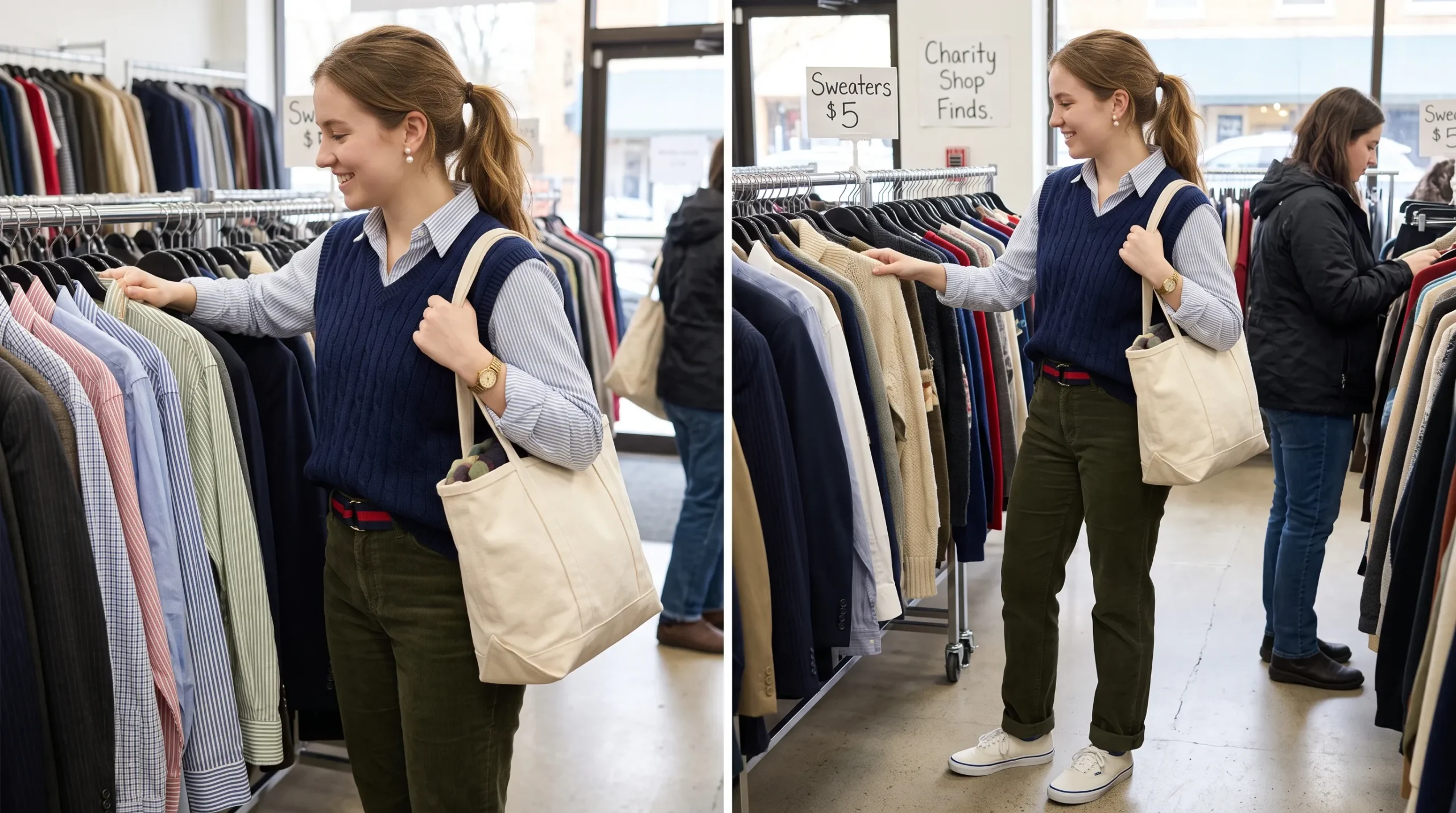
You dress preppy on a low budget by building a capsule wardrobe of fifteen interchangeable pieces in a coordinated colour palette — navy, white, cream, khaki — sourced from mid-range or secondhand retailers, prioritised by cost-per-wear rather than brand name. The total cost: under PKR 15,000 in Pakistan or under $200 from Western mid-range brands.
The assumption that preppy requires expensive labels is the single biggest barrier keeping budget-conscious dressers from an aesthetic that was literally designed around reusable basics. According to a 2026 analysis by The Modest Man, a $50 jacket tailored to fit correctly outperforms a $500 designer piece that sags at the shoulders. The preppy system’s real value is structural: every piece works with every other piece, which means fewer total garments produce more total outfits. After styling clients across Pakistan and abroad at every price point, the pattern is clear — fit, fabric weight, and colour coordination beat branding every time.
Dressing preppy on a low budget works because the aesthetic is built on a closed system of interchangeable basics rather than statement pieces. A capsule wardrobe — a small, curated collection of clothing designed so every item pairs with multiple others — is the mechanism that makes budget preppy functional. The core pieces are oxford cloth button-down shirts (OCBDs), polo shirts in piqué cotton, chino trousers in cotton twill, a navy blazer, cable-knit sweaters, and leather loafers.
These six categories, purchased in a coordinated palette of navy, white, cream, and khaki, generate forty or more outfit combinations from as few as fifteen individual items. Lisa Birnbach, author of the 1980 Official Preppy Handbook, described the philosophy as accumulating “with some care — not too much care, just the right amount.”
In 2026, brands like Uniqlo (whose JW Anderson Spring/Summer 2026 collaboration includes oversized OCBDs and piqué polos), J.Crew Factory, and Pakistani retailers like Outfitters, Charcoal, and Cambridge produce every foundational preppy piece at price points accessible to university students and entry-level professionals. The budget constraint is not a limitation of the aesthetic. It is the aesthetic — preppy style is a system of fewer, better basics worn in coordinated combinations.
How Much Does It Actually Cost to Dress Preppy on a Low Budget?
A complete preppy capsule of fifteen pieces costs between PKR 12,000 and PKR 18,000 when sourced from Pakistani brands, or between $150 and $250 from Western mid-range retailers. Secondhand sourcing cuts those numbers by forty to sixty percent.
Here is the math for a full starter capsule, with real 2026 price ranges from accessible brands:
| Piece | Pakistani Brands (PKR) | Western Mid-Range (USD) | Secondhand (USD) |
|---|---|---|---|
| 2 OCBDs (white, light blue) | 2,000–3,500 | $30–50 | $8–15 |
| 2 polo shirts (navy, white) | 1,500–3,000 | $20–40 | $6–12 |
| 2 chinos (khaki, navy) | 2,000–4,000 | $30–60 | $10–20 |
| 1 dark-wash jeans | 1,500–3,000 | $25–50 | $8–15 |
| 1 navy blazer (unstructured) | 3,000–6,000 | $40–80 | $15–30 |
| 1 cable-knit sweater | 1,500–3,500 | $25–50 | $8–18 |
| 1 striped rugby or Breton shirt | 1,000–2,500 | $15–35 | $5–12 |
| 1 pair loafers or boat shoes | 2,500–5,000 | $35–70 | $12–25 |
| 1 pair white sneakers | 1,500–3,500 | $25–50 | $10–20 |
| 1 canvas tote | 500–1,500 | $10–25 | $3–8 |
| 1 grosgrain or surcingle belt | 500–1,200 | $8–20 | $3–8 |
| Total (15 pieces) | PKR 17,500–39,700 | $263–530 | $88–183 |
The “starter” column targets the lower end of each range. A disciplined shopper buying during sales — Outfitters and Charcoal run 30–50% end-of-season discounts in Pakistan; J.Crew Factory and ASOS run permanent markdowns — lands well inside the PKR 15,000 or $200 ceiling.
But here is what most budget guides miss: the buy order matters more than the total cost.
What Pieces to Buy First (The Budget Priority Matrix)
Most preppy guides list pieces as an unranked pile. That works if you have unlimited funds. On a budget, the sequence of purchases determines how fast the wardrobe becomes functional.
This matrix ranks each piece by three criteria scored 1–5: cost-per-wear (how often you will wear it), outfit multiplier (how many new outfits it creates when added to existing pieces), and visual signal (how much it changes the overall impression from “regular” to “preppy”). Buy in descending order of total score.
| Piece | Cost-per-Wear | Outfit Multiplier | Visual Signal | Total | Buy Order |
|---|---|---|---|---|---|
| White OCBD | 5 | 5 | 4 | 14 | 1st |
| Khaki chinos | 5 | 5 | 3 | 13 | 2nd |
| Navy blazer | 4 | 4 | 5 | 13 | 3rd |
| Loafers | 4 | 4 | 5 | 13 | 4th |
| Light blue OCBD | 5 | 4 | 3 | 12 | 5th |
| Navy polo | 5 | 4 | 3 | 12 | 6th |
Start with the top four. A white OCBD, khaki chinos, a navy blazer, and a pair of loafers give you a complete preppy foundation. Those four pieces alone produce six distinct outfits (blazer on/off, shirt tucked/untucked, rolled/unrolled sleeves) and cost under PKR 8,000 from Pakistani brands or under $100 from Western sale racks.
Each subsequent purchase builds on the foundation rather than sitting in isolation. The navy polo (buy #6) works with the khaki chinos (buy #2) and the blazer (buy #3). The light blue OCBD (buy #5) pairs with the navy blazer (buy #3). Nothing is orphaned. Every addition multiplies existing combinations rather than adding a standalone look.
Why Fit Beats Brand Name Every Single Time
A PKR 2,000 polo that sits correctly on your shoulders outperforms a PKR 12,000 branded polo that sags at the seams. Fit is the single largest determinant of whether an outfit reads as “polished” or “sloppy” — and it costs nothing extra if you buy the right size in the first place.
The preppy system is especially sensitive to fit because its pieces lack the visual complexity that masks poor tailoring in other aesthetics. A graphic tee hides a loose midsection. A streetwear hoodie is designed to be oversized. An OCBD or a blazer has nowhere to hide. Every seam is visible. Every proportion is exposed.
Three fit rules that cost zero money:
Shoulders first. The shoulder seam of any shirt, blazer, or sweater should sit exactly at the point where your shoulder ends and your arm begins. Buy for your shoulder measurement and tailor everything else. According to Man of Many (2026), spending $30 on a basic alteration — darting a shirt, hemming trousers — makes a $50 garment look ten times its price.
Sleeve length second. Shirt sleeves should end at the wrist bone. Blazer sleeves should show roughly 1.5cm of shirt cuff below the jacket. Polo sleeves should hit at mid-bicep.
Length third. An untucked OCBD should end at mid-fly. A tucked OCBD should have enough fabric to stay tucked without pulling loose when you sit down. Chinos should break once at the shoe — no pooling, no bare ankle unless that is a deliberate summer choice.
A quick test before purchasing: sit down in the garment. If the shirt pulls free from the waist, the blazer bunches at the shoulders, or the chinos ride above the ankle, the fit is wrong regardless of how it looked standing in front of the mirror.
Where to Buy Preppy Clothes on a Tight Budget
The sourcing strategy matters as much as the pieces themselves. Buying the right garment from the wrong source is the fastest way to overspend.
Pakistan and South Asia
Pakistani brands produce the full range of preppy basics at student-accessible prices. Outfitters (polo shirts PKR 1,000–2,500, chinos PKR 1,800–3,500), Charcoal (tailored shirts and blazers at competitive pricing), and Cambridge (office-ready trousers and dress shirts) cover the foundation. Levi’s Pakistan stocks dark-wash denim in locally priced ranges. Bonanza Satrangi carries knitwear and cotton basics in the neutral palette preppy demands.
A one-day sourcing route in Lahore, Karachi, or Islamabad: start at an Outfitters outlet for polos and casual shirts, add Charcoal for a cotton blazer, and finish at a Bata or Borjan outlet for loafers. Total spend for the top-four foundation: PKR 6,000–10,000 at full price, lower during end-of-season sales.
For readers building a student capsule wardrobe for campus, the combination of Outfitters basics and Bonanza knitwear covers autumn-through-spring in most Pakistani cities.
Western Mid-Range
Uniqlo, J.Crew Factory, and ASOS produce every preppy staple at the price points in the table above. The Uniqlo x JW Anderson Spring/Summer 2026 collection includes oversized OCBDs and piqué polos — both core preppy pieces — at standard Uniqlo pricing. Gap and Old Navy run permanent sale rotations that bring polos and chinos below $20.
Secondhand and Thrift
Secondhand is the single most powerful budget lever in preppy dressing. Preppy pieces — OCBDs, blazers, chinos, cable knits, loafers — are among the most commonly donated items in thrift stores because their owners upgrade rather than wear them out. A wool blazer from Brooks Brothers or a Ralph Lauren OCBD found at a thrift shop for $8–15 is often better-constructed than a new fast-fashion equivalent at three times the price.
Before buying secondhand, inspect four things: seams (no fraying), buttons (all present and secure), fabric (no pilling, no stains, no thinning at elbows), and care label (natural fibres hold up better than blends over time). A Mens Minimal (2026) guide to vintage preppy clothing recommends checking collar construction on blazers — a canvas-interlining collar holds its shape for decades, while a fused interlining bubbles after a few dry cleans.
The Colour Coordination Rule That Makes Budget Preppy Work
The reason fifteen pieces produce forty-plus outfits is colour coordination. Without it, every piece exists in isolation. With it, every piece multiplies.
Preppy follows a four-tier palette system:
Foundation (60%): Navy, white, cream, khaki, light blue, grey. Every foundation piece pairs with every other foundation piece. A white OCBD works with khaki chinos, navy chinos, and dark jeans. Navy chinos work with a white polo, a light blue OCBD, and a cream sweater.
Accent (25%): Hunter green, burgundy, mustard, coral, pink. Accent pieces pair with all foundation pieces but not necessarily with each other. A burgundy polo works with khaki chinos. A hunter green sweater works over a white OCBD.
Pattern (10%): Stripes (Breton, regimental), plaid (madras, tartan), argyle, gingham. Pattern pieces pair with solid foundation pieces only. A Breton-striped shirt pairs with navy or khaki. Madras pairs with white or cream.
Pop (5%): One or two bright, saturated pieces — a red rugby, a yellow belt. Used sparingly.
The budget principle: build foundation first, then accent, then pattern, then pop. If you are buying your first five pieces, all five should be foundation colours. This maximises outfit combinations per piece purchased. A wardrobe of five navy-and-white pieces produces more wearable outfits than a wardrobe of five pieces in five different colours.
Most budget preppy fails happen when someone buys a coral polo before owning a white OCBD. The coral polo is beautiful — and it sits in the closet unworn because nothing else in the wardrobe coordinates with it at the right formality level.
Five Budget Styling Tricks That Make Cheap Clothes Look Expensive
These five techniques cost nothing. They work on garments at every price point. Each one closes the visual gap between a PKR 2,000 outfit and a PKR 20,000 one.
1. Iron or steam everything. A wrinkled OCBD from J.Crew Factory looks cheaper than a pressed OCBD from a thrift shop. Five minutes with an iron before leaving the house changes the entire impression of a shirt. Steamers work faster on cotton and linen.
2. Roll sleeves consistently. The “master roll” — fold the cuff back once to just below the elbow, then fold one more time to lock it in place — is the signature casual preppy move. Bunched-up, uneven rolls look sloppy regardless of the shirt’s price tag.
3. Replace cheap buttons. Swap the plastic buttons on a PKR 1,500 blazer for horn or metal buttons at PKR 200–400 total. That single change makes the blazer read as two to three times its actual price. Tailors in most Pakistani cities do this for under PKR 500 including buttons.
4. Use one accent accessory. A grosgrain belt, a simple watch, or a pair of clean sunglasses. One well-chosen accessory signals intention. Three or more signals costume. Budget preppy leans toward restraint.
5. Polish leather. Clean and condition your loafers once a month. Scuffed, dusty leather is the single fastest way to make an outfit look neglected. A PKR 300 tin of shoe polish and five minutes of buffing produce a visible difference.
How to Adapt Budget Preppy for Hot Climates
Most preppy guides assume a temperate Northeastern American climate. That framework breaks down anywhere temperatures exceed 35°C for six months of the year — which describes most of Pakistan, South Asia, and the Middle East.
The fix is fabric, not silhouette.
Replace wool with linen and lightweight cotton. Swap heavy cable knits for fine-gauge cotton or cotton-linen blend sweaters worn only in air-conditioned environments or cooler winter evenings. Choose unstructured, unlined blazers over padded British construction. Prioritise breathable weaves: madras, seersucker, linen, and high-thread-count cotton poplin.
The silhouettes stay identical. The OCBD still works — in a lighter-weight oxford or poplin. Chinos still work — in a cotton-linen blend. The navy blazer still works — unlined, in cotton or a cotton-linen composition.
Preppy also layers cleanly alongside eastern wear. Chinos pair with kurtas for hybrid campus looks. Loafers and clean white sneakers sit comfortably next to both western trousers and shalwar. The aesthetic’s modesty — no extreme cuts, no excessive exposure, no loud branding — aligns with cultural norms across Pakistan and South Asia more naturally than most Western fashion systems. An occasion-appropriate ensemble built from preppy basics works for both semi-formal family dinners and casual office days.
Common Budget Preppy Mistakes (and the Fixes)
Buying brand before basics. A PKR 8,000 Ralph Lauren polo is a poor first purchase if you do not yet own chinos to wear with it. Buy the system first. Add branded upgrades later when the foundation is complete.
Ignoring fabric weight. A heavy wool cable knit in Karachi’s July does not look polished. It looks like a mistake. Match fabric weight to your actual climate.
Treating preppy as head-to-toe costume. Mix one or two preppy pieces with your existing wardrobe. A navy blazer over a plain white t-shirt and jeans is preppy. A blazer over an OCBD with chinos, a ribbon belt, loafers, and a pocket square is a costume.
Shopping without a list. Budget preppy fails when purchases are impulse-driven. Use the priority matrix above. Walk into the store knowing exactly which piece you need next. Walk out with that piece and nothing else.
Skipping maintenance. The difference between a polished preppy wardrobe and a sloppy one is maintenance, not money. Ironing, shoe care, button replacement, and proper storage — hangers for blazers, folding for knitwear — cost almost nothing and extend the visual life of every garment by years.
Frequently Asked Questions About Dressing Preppy on a Budget
Can you dress preppy for under PKR 10,000?
Yes. Focus on the top four from the priority matrix — a white OCBD, khaki chinos, a navy blazer, and loafers — sourced during end-of-season sales from Outfitters, Charcoal, or comparable Pakistani brands. Those four pieces create a functional preppy foundation for PKR 6,000–10,000.
Is thrifting a good strategy for preppy clothes?
Thrifting is the strongest budget strategy for preppy because the pieces most commonly donated — blazers, OCBDs, cable knits, chinos, loafers — are exactly the pieces the aesthetic requires. Inspect seams, buttons, and fabric before purchasing. Secondhand preppy pieces are often better-constructed than new fast-fashion equivalents.
Does preppy have to be expensive?
No. The preppy aesthetic originated in expensive circles, but the actual garments — polo shirts, chinos, oxford shirts, blazers — are produced by brands at every price point worldwide. The system’s value is structural: coordinated basics that combine into many outfits.
What is the single most important piece to buy first on a budget?
A white oxford cloth button-down shirt. It scores highest on the priority matrix across cost-per-wear, outfit multiplier, and visual signal. A well-fitted white OCBD works with chinos, jeans, blazers, and sweaters in both casual and semi-formal contexts.
How do I make cheap preppy clothes look more expensive?
Iron everything, polish leather shoes monthly, replace plastic buttons with horn or metal, use one accent accessory rather than several, and buy for fit rather than brand. These five steps cost almost nothing and close the visual gap between budget and designer garments.
Does preppy style work in hot climates like Pakistan?
Yes. Swap heavy fabrics for linen, cotton poplin, and fine-gauge cotton knits. The silhouettes, colours, and combinations stay identical. Preppy’s modest, structured approach aligns naturally with cultural norms in South Asia.
Your Next Move
Dressing preppy on a low budget is not a compromise. It is the aesthetic working as designed — a closed system of coordinated basics that produces maximum outfits from minimum pieces. Start with the top four: a white OCBD, khaki chinos, a navy blazer, and loafers. Source them from the brands and channels listed above during the next sale cycle. Wear them together once. Add one piece per month from the priority matrix. Within three months, you will have a fifteen-piece capsule that generates more wearable outfits than a closet three times its size.
If you want that capsule personalised — matched to your body type, your city’s climate, your specific budget, and the occasions your wardrobe needs to serve — send us a brief and we will build it for you. Every plan is built from brands you can actually buy, at a price you actually set.